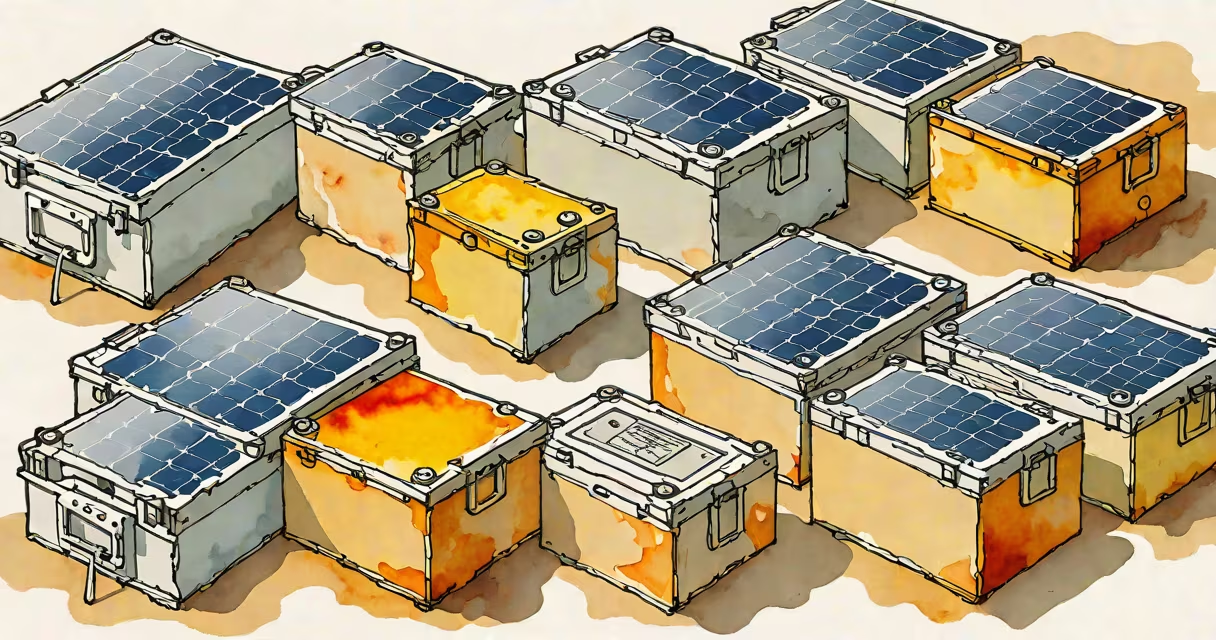
Solar batteries store excess solar energy for later use, typically in lithium-ion, lead-acid, or flow battery designs. They bridge gaps between energy production and consumption, especially for off-grid systems or time-of-use billing.
Solar panels generate DC electricity during daylight hours. When demand exceeds production, stored energy discharges from the battery. At night or during cloudy periods, stored energy powers homes or businesses. Advanced systems integrate with smart inverters and energy management software.
| Type | Capacity Range | Lifespan | Efficiency | Best For |
|---|---|---|---|---|
| Lithium-Ion | 5-20 kWh | 10-15 years | 90-95% | Residential, commercial |
| Lead-Acid | 2-10 kWh | 3-7 years | 70-80% | Budget systems |
| Flow Battery | 10-100 kWh | 15-20 years | 70-80% | Large-scale storage |
Many assume all solar batteries last decades. While some flow batteries reach 20 years, most residential systems use lithium-ion batteries with 10-15 year lifespans. A 2021 study by NREL found that proper temperature control extends lithium-ion battery life by 20-30%.
Another myth suggests solar batteries store days of power. Most residential systems provide 1-2 days of backup. For extended outages, hybrid systems combining batteries with generators work better. I installed a 10 kWh lithium-ion system in 2020 that powers my home for 18 hours during grid outages.
Residential installations account for 60% of solar battery deployments, according to SEIA. Commercial applications include microgrids for schools and hospitals. Utility-scale projects often use flow batteries due to their scalability. For example, the Hawaiian Electric company's 2022 project paired a 100 MW solar farm with a 100 MWh flow battery system.
Off-grid systems in remote areas rely on solar batteries combined with wind turbines. These hybrid systems provide reliable power where grid connections are impractical. A 2023 report by IEA highlighted that global solar battery capacity grew 40% annually from 2018-2022.
Uninterruptible Power Supplies (UPS) and solar batteries both provide backup power, but UPS systems handle brief outages while solar batteries support longer durations. UPS systems typically use lead-acid batteries, whereas solar batteries often use lithium-ion for higher efficiency. Some hybrid inverters combine both technologies for optimal performance.
Another confusion arises with solar inverters. While inverters convert DC to AC power, solar batteries store excess energy for later use. High-quality inverters integrate with battery management systems to improve charging/discharging cycles. For instance, the Tesla Powerwall includes an integrated inverter for smooth operation.