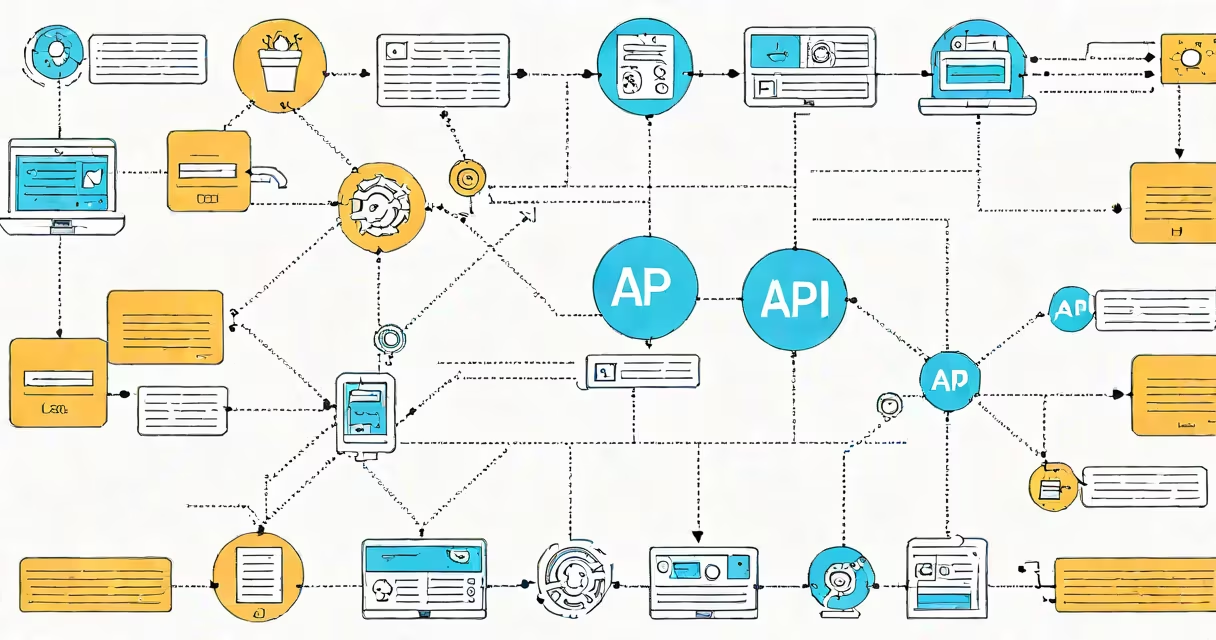
An API (Application Programming Interface) is a set of protocols that allows different software applications to communicate. It defines methods for requesting and exchanging data between systems.
APIs act as intermediaries, letting separate applications talk to each other without sharing their underlying code. When you use an app like Google Maps on your phone, an API sends your location data to Google's servers, which then send back map images and directions.
| Type | Description | Example |
|---|---|---|
| Web API | Uses HTTP protocol to exchange data over the web | Twitter API lets developers access tweets programmatically |
| Library API | Provides predefined functions for software development | Python's math library API offers mathematical operations |
| Operating System API | Allows programs to use operating system features | Windows API enables applications to interact with Windows |
| Database API | Provides methods for database access and manipulation | SQL API lets applications query databases |
Many people confuse APIs with databases or user interfaces. Unlike databases, APIs don't store data-they provide access to data or functionality. And unlike user interfaces, APIs don't interact with humans directly; they connect software components.
Another common mistake is thinking APIs are only for web services. While web APIs are popular, APIs exist for all kinds of software, including operating systems, libraries, and hardware devices.
When you check the weather on your phone, an API makes this possible. Your weather app sends your location to a weather service's API. The API processes this request, accesses current weather data, and sends it back to your app in a readable format. This entire process happens in seconds.
I once built a simple weather application using a free weather API. The API documentation showed me exactly how to structure my requests and what kind of data to expect in return. Without this API, I would have needed to create my own weather data infrastructure, which would have been far more complex and time-consuming.
According to ProgrammableWeb, there are over 24,000 public APIs available today, showing their widespread adoption across industries. APIs power everything from social media integrations to payment processing systems.
APIs improve by allowing developers to build on existing technologies without needing to understand their internal workings. They save time, reduce complexity, and enable the creation of new services by combining existing ones in novel ways.