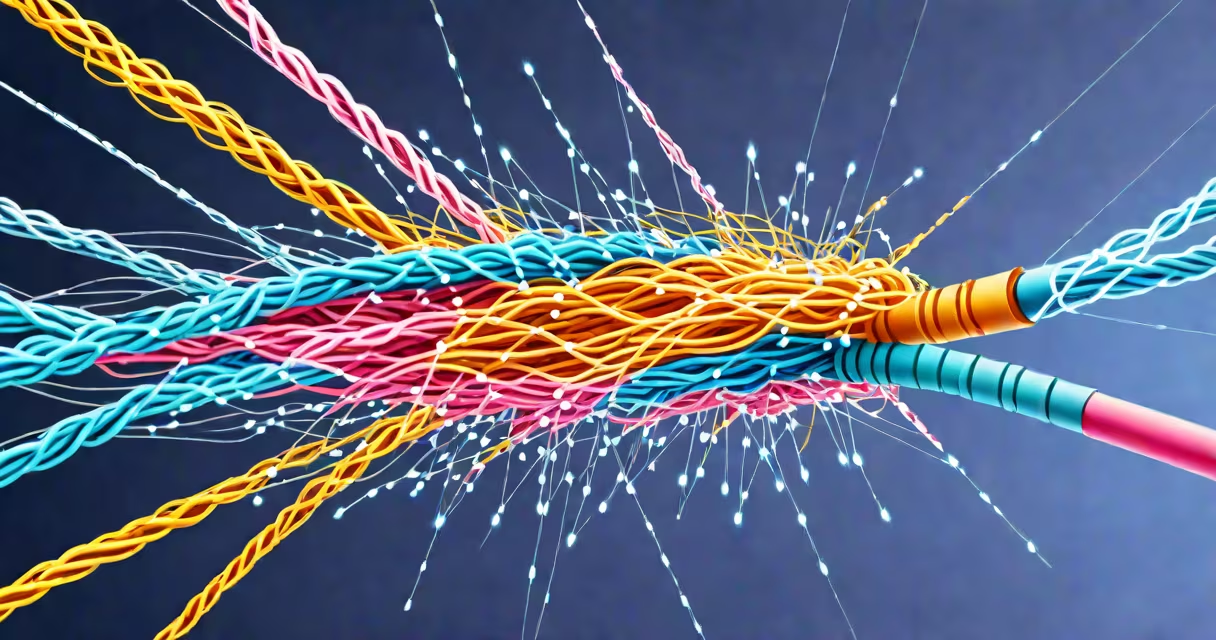
Fibre optic is a technology that uses thin glass or plastic fibers to transmit data as light pulses, enabling faster internet speeds and clearer communication than traditional copper wires.
Fibre optic cables carry data as light signals through tiny strands of glass or plastic called optical fibers. A laser or LED light sends pulses of light through the core of the fiber, while the cladding (outer layer) reflects the light inward, keeping the signal contained. This process allows data to travel long distances with minimal loss of signal quality.
For example, a single fibre optic strand can carry up to 10 gigabits per second (Gbps) of data, which is faster than traditional copper cables. The light pulses are converted back to electrical signals at the receiving end, allowing devices to interpret the data.
| Type | Description | Common Uses |
|---|---|---|
| Single-mode fiber | Thinner core (9 micrometers) for long-distance communication | Telecommunications, undersea cables |
| Multimode fiber | Thicker core (50-62.5 micrometers) for shorter distances | Local area networks (LANs), data centers |
Fibre optic cables transmit data as light, which travels faster and with less interference than electrical signals in copper wires. Light signals in fibre optic cables experience less attenuation (signal loss) over long distances, making them ideal for high-speed internet and telecommunications.
For instance, a fibre optic connection can deliver speeds up to 10 Gbps, while the fastest copper-based DSL connections max out at around 100 Mbps. This speed difference makes fibre optic the preferred choice for broadband internet providers and businesses requiring high-bandwidth applications.
Many people confuse fibre optic with other high-speed technologies, such as satellite or wireless broadband. Unlike these alternatives, fibre optic provides consistent, high-speed connectivity without signal degradation over distance., fibre optic is not affected by electromagnetic interference, unlike copper cables.
Another misconception is that fibre optic is fragile. While the glass fibers are delicate, they are protected by multiple layers of protective coatings and cables, making them durable enough for underground and underwater installations.
Fibre optic technology is used in various industries, including telecommunications, medical imaging, and military applications. For example, hospitals use fibre optic endoscopes to perform minimally invasive surgeries, while telecommunications companies rely on fibre optic cables to provide high-speed internet access to homes and businesses.
I once visited a data center where fibre optic cables were used to connect servers, ensuring lightning-fast data transfer between machines. The cables were neatly organized and labeled, highlighting the importance of proper installation and maintenance.