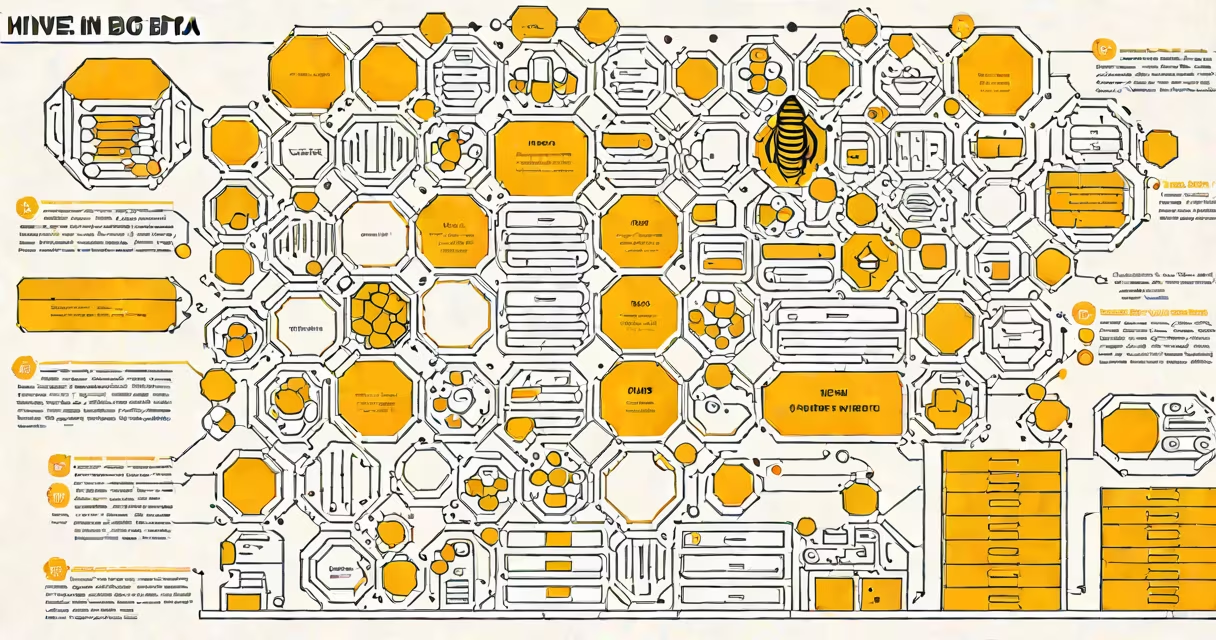
Apache Hive is an open-source data warehouse infrastructure built on top of Hadoop for querying and analyzing large datasets stored in distributed storage using a SQL-like interface called HiveQL.
Hive translates HiveQL queries into MapReduce, Tez, or Spark jobs, which are then executed on the Hadoop cluster. It provides a schema-on-read approach, meaning the structure of the data is applied when it is read, not when it is written. This allows Hive to work with unstructured, semi-structured, and structured data.
The key components of Hive include:
| Table Type | Description | Use Case |
|---|---|---|
| Managed Tables | Hive manages the lifecycle of the data, including creation, deletion, and storage location. | Ideal for temporary data or when Hive should control the data. |
| External Tables | Hive does not manage the data lifecycle. The data is stored externally, and Hive only manages the metadata. | Useful for integrating with existing data systems or when data should persist beyond the table's lifecycle. |
| Partitioned Tables | Data is divided into partitions based on a specific column or set of columns. | Improves query performance by reducing the amount of data scanned. |
One common misconception is that Hive is a database. While it provides a SQL-like interface, it is not a database management system (DBMS). Unlike traditional databases, Hive does not support real-time updates or transactions. It is designed for batch processing and querying large datasets.
Another mistake is assuming Hive is only for structured data. Hive can handle unstructured and semi-structured data as well, thanks to its schema-on-read approach. For instance, Hive can process JSON files, XML files, and even log files by defining appropriate schemas during query execution.
According to the Apache Hive documentation, Hive supports several file formats, including TextFile, SequenceFile, ORC, and Parquet. Each format has its advantages for storage efficiency, compression, and query performance.
In my experience working with Hive, I found that understanding the underlying storage formats and their implications on query performance is important. For example, columnar formats like ORC and Parquet improve query performance for analytical workloads due to their efficient storage and compression mechanisms.
Unlike traditional databases, Hive is not designed for online transaction processing (OLTP). Instead, it excels at online analytical processing (OLAP), where complex queries are run against large datasets. Traditional databases use a schema-on-write approach, where the structure of the data is defined before it is written. In contrast, Hive uses a schema-on-read approach, allowing for more flexible data ingestion and processing.