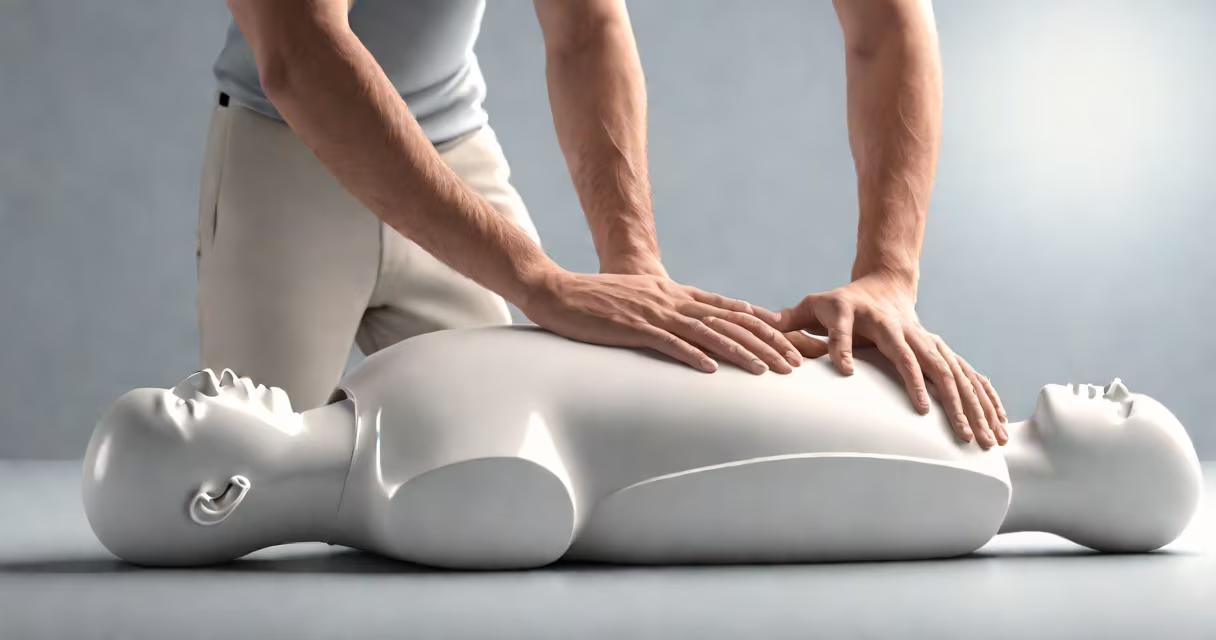
Cardiopulmonary resuscitation (CPR) is an emergency lifesaving technique involving chest compressions and rescue breaths to restore blood flow and breathing in someone whose heart has stopped.
When performed correctly, CPR keeps oxygen-rich blood flowing to important organs until medical help arrives. The American Heart Association recommends immediate CPR for anyone who is unresponsive and not breathing normally.
CPR combines chest compressions with rescue breaths to simulate the heart's pumping action and provide oxygen to the lungs. Compressions force blood out of the heart, while breaths inflate the lungs.
The standard ratio is 30 compressions to 2 breaths for adults and children. For infants, the ratio is 30 compressions to 2 breaths. Compressions should be at least 2 inches deep for adults and about 1.5 inches for infants.
| Type | Description | When Used |
|---|---|---|
| Conventional CPR | Combination of chest compressions and rescue breaths | General use for all ages |
| Hands-only CPR | Chest compressions only, no rescue breaths | Used on adults in cardiac arrest |
| Continuous-CheST-Compression CPR | Nonstop compressions with minimal interruptions | Used during out-of-hospital cardiac arrests |
Many people think CPR always involves mouth-to-mouth breaths. However, hands-only CPR is recommended for untrained bystanders performing CPR on adults in cardiac arrest. Another misconception is that CPR can restart the heart. In reality, CPR maintains circulation until defibrillation can be performed.
Some believe CPR is only for heart attacks. While CPR is often performed after heart attacks, it's also used for drowning victims, electric shocks, and other causes of sudden cardiac arrest.
Use CPR when someone is unresponsive and not breathing normally. Check for responsiveness by tapping the person and shouting. Look for normal breathing by checking for rise and fall of the chest for 5-10 seconds. If no breathing is detected, begin CPR immediately.
Call emergency services before starting CPR if you're alone. If someone else is present, have them call while you begin CPR. Do not interrupt CPR to check for a pulse unless the person shows signs of life.
During my CPR certification course, I practiced on a mannequin with a feedback device. The device measured compression depth, rate, and recoil. It was surprising how tiring continuous compressions became after just a few minutes. This experience reinforced the importance of switching rescuers every two minutes during prolonged CPR.
I also learned that proper hand placement is important. For adults, place the heel of one hand in the center of the victim's chest and the other hand on top. For infants, use two fingers placed in the center of the chest.
For more detailed information on CPR techniques and training, visit the American Heart Association website. They offer complete guidelines and certification courses for both professional rescuers and laypeople.
Understanding the meaning of CPR in medical terms can also provide deeper insight into its importance and application in clinical settings.