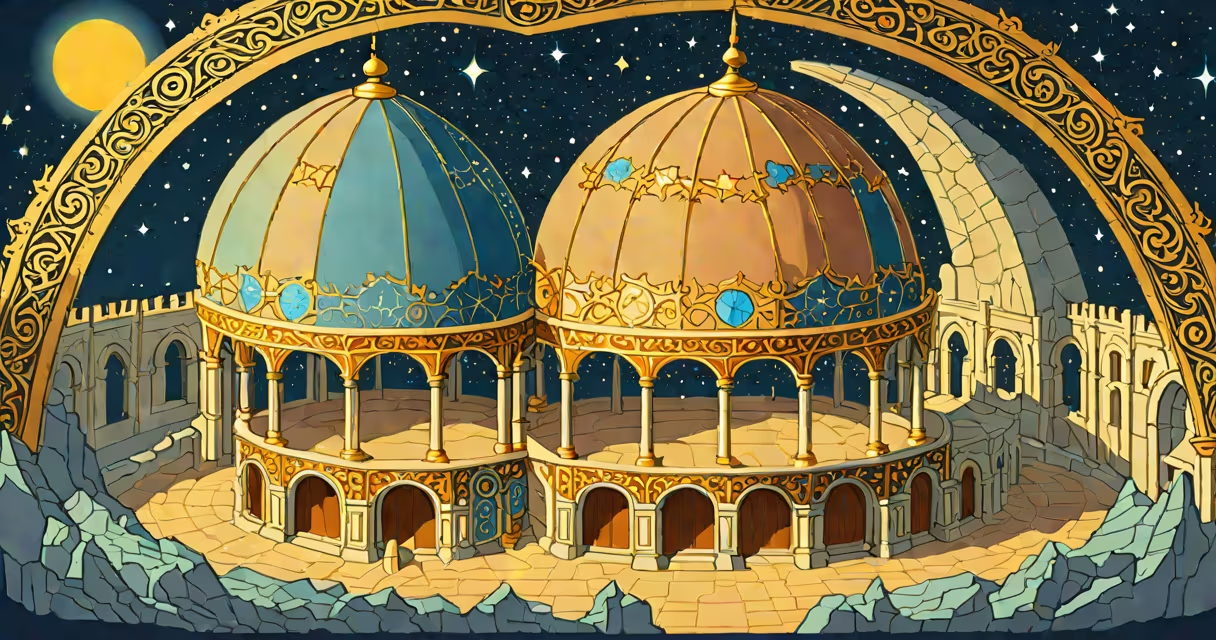
The firmament is the solid dome described in the Bible as separating the waters above from the waters below during creation. This ancient concept shaped early understandings of the sky.
Genesis 1:6-8 describes God creating the firmament to divide the waters, calling it "heaven." This wasn't just empty space - it was a tangible structure holding back cosmic waters, with windows (later opened during the flood) and stars embedded in it.
Most English translations use "expanse" or "vault," but the original Hebrew word (raqia) suggests something solid yet transparent, like hammered metal. This aligns with ancient Near Eastern cosmologies where the sky was often depicted as a rigid dome.
| Interpretation | Key Features | Example Source |
|---|---|---|
| Literal Dome | Physical structure holding back waters | Genesis 1:6-8 |
| Atmospheric Layer | Visible sky separating earth from heavens | Job 37:18 |
| Celestial Sphere | Transparent sphere containing stars | Psalm 19:1 |
The firmament appears in creation accounts across Mesopotamian cultures. The Bible's version uniquely emphasizes God's creative power by describing how He "stretched out" this structure (Isaiah 42:5). This imagery reassured ancient audiences about cosmic order while demonstrating divine control.
One non-obvious fact: the firmament's windows (Genesis 7:11) weren't just decorative - they explained rainfall in pre-scientific times. When opened, they released stored waters above the firmament to water the earth.
Many assume the firmament was purely symbolic, but ancient texts treat it as physical reality. Even modern expressions like "the vault of heaven" preserve this concrete imagery. Another mistake is conflating it with modern astronomical concepts - the firmament wasn't just "space," but a structured boundary.
Consider Ezekiel's vision (Ezekiel 1:22, 26): "The likeness of the firmament upon the heads of the living creatures was like the color of crystal-like ice." This describes a transparent, hard surface above angelic beings, reinforcing the firmament's role as both barrier and pathway between heavenly realms. Such passages show how thoroughly this concept permeated biblical cosmology.
When researching this, I was surprised to find how consistently the firmament appears in ancient texts beyond the Bible. From Babylonian Enuma Elish to Egyptian creation myths, this sky-dome motif appears worldwide, suggesting shared cultural foundations for early cosmological thought.