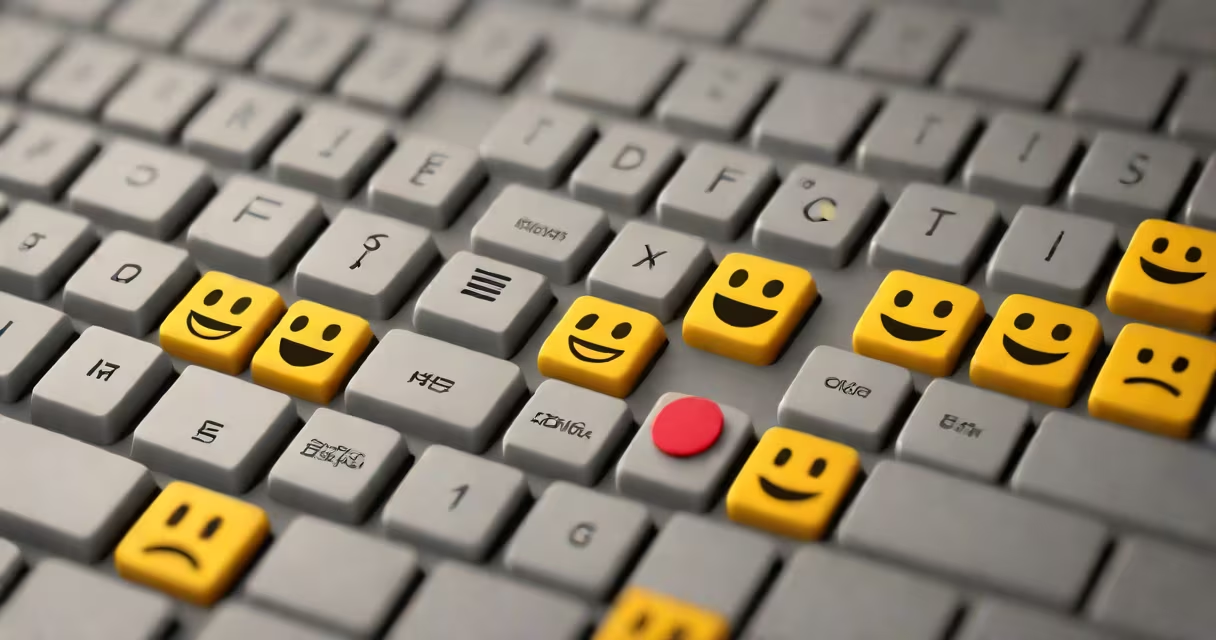
An emoticon is a text-based symbol that represents an emotion or facial expression, such as :) for happiness or :( for sadness. These symbols use punctuation marks and letters to create visual representations of emotions in written communication.
Emoticons work by arranging characters to resemble facial expressions when viewed sideways. For example, typing ":)" and tilting your head to the left shows a smiling face. This technique allows people to convey emotions in text messages, emails, and social media posts where tone is otherwise ambiguous.
| Emoticon | Meaning |
|---|---|
| :-) | Smile |
| :-( | Frown |
| ;) | Wink |
| :D | Big grin |
| :P | Stick out tongue |
Emoticons are used in various forms of digital communication to add emotional context to text. They are particularly useful in casual conversations where tone can be easily misinterpreted. For example, adding a smiley face (:)) to a message can soften a potentially harsh statement and make it clear that the sender is joking.
Emoticons are often confused with emojis, but they are different. Emoticons are made using keyboard characters, while emojis are small digital images or icons. Emoticons have been around since the early days of the internet, whereas emojis were introduced later as part of the Unicode standard. Emoticons require more creativity and imagination to interpret, while emojis are more universally understood.
For example, the emoticon ":)" is universally recognized as a smile, but the exact same smile can be represented by the emoji 😊. The difference lies in the form: one is text-based, and the other is image-based.
One common misconception is that emoticons are outdated and no longer used. However, they are still widely used, especially in environments where emojis are not supported or in contexts where text-based symbols are preferred. Another misconception is that emoticons are only used for positive emotions. In reality, they can represent many emotions, including sadness, anger, confusion, and more.
Here are a few examples of how emoticons are used in everyday communication:
Emoticons can also be combined to create more complex expressions. For example, ":O" can represent surprise, while ":|" can indicate indifference. The versatility of emoticons allows for many emotional expressions in text-based communication.
The meaning of emoticon lies in their ability to convey emotions through simple text-based symbols. They play a important role in digital communication by adding emotional context to written messages. While they are often confused with emojis, emoticons remain a popular and effective way to express emotions in text. Understanding and using emoticons can improve communication and prevent misunderstandings in various online interactions.