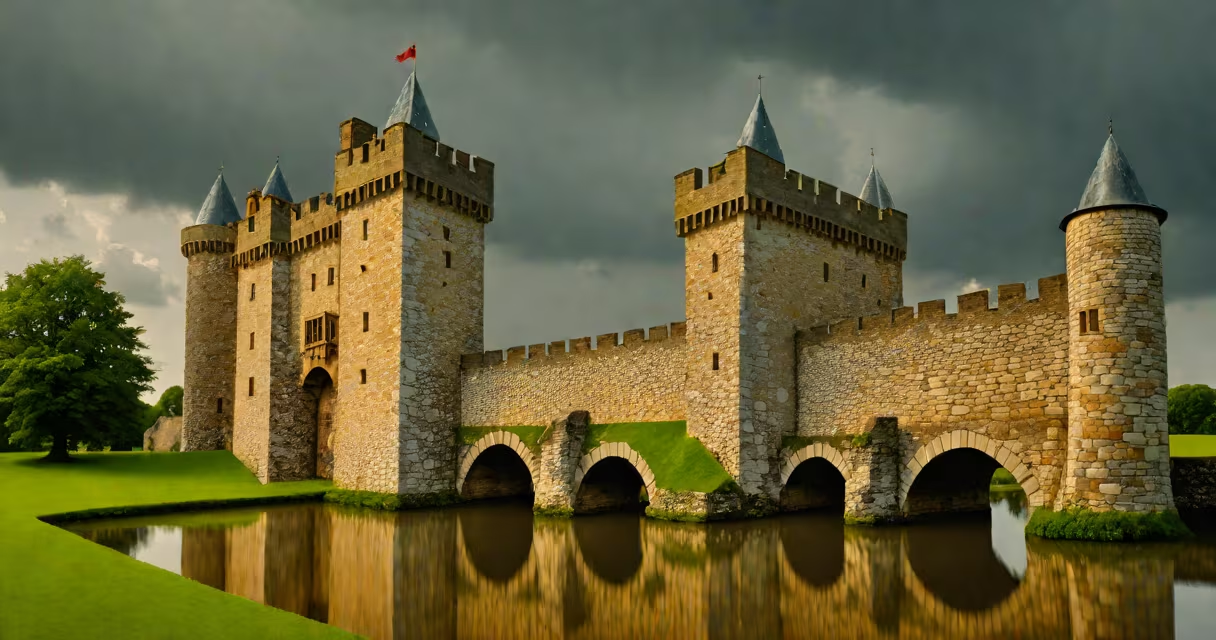
The term medieval describes the Middle Ages, a 1,000-year period between the fall of Rome (5th century) and the Renaissance (15th century). It encompasses feudalism, the rise of Christianity, and the Black Death.
The medieval era spans from roughly 500 CE to 1500 CE. It follows the classical antiquity period and precedes the early modern period. The term "medieval" comes from the Latin word "medium," meaning middle, reflecting its position between ancient and modern times.
This period is divided into three sub-periods:
The medieval period is characterized by several key features:
| Feature | Description |
|---|---|
| Feudalism | A political system where land was exchanged for military service and loyalty. |
| Manorialism | A system where peasants worked on lords' lands in exchange for protection and land to farm. |
| Chivalry | A code of conduct for knights emphasizing bravery, honor, and courtesy. |
| Religion | The Catholic Church played a central role in medieval society, influencing politics, education, and daily life. |
The term "medieval" is used in historical contexts to describe the Middle Ages. It is also used in popular culture to evoke images of castles, knights, and dragons. However, it is often misunderstood as a time of darkness and backwardness, a misconception known as the "Dark Ages."
In reality, the medieval period was a time of significant cultural, technological, and intellectual development. For example, universities were founded, Gothic architecture emerged, and the printing press was invented towards the end of the period.
One common misconception is that the medieval period was a time of stagnation. In reality, it was a time of significant innovation and change. For instance, the Magna Carta, signed in 1215, laid the foundation for modern constitutional law.
Another misconception is that the medieval period was entirely religious. While the Church was useful, medieval society was diverse and included people of different faiths and backgrounds.
I once visited a medieval castle in France. The guide explained how the castle's design reflected the period's military strategies and social structures. It was fascinating to see how the past shaped the present.