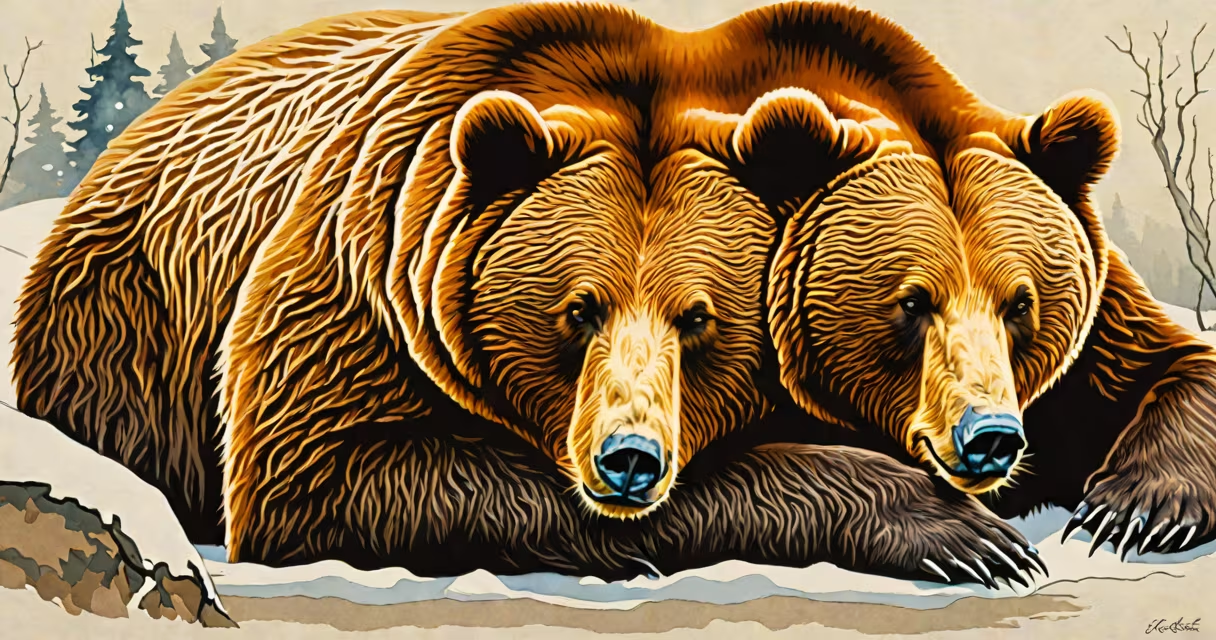
Bears hibernate to conserve energy during winter when food is scarce. Unlike true hibernators, they maintain higher body temperatures and can wake easily.
Bear hibernation is actually a state called torpor. Their metabolism slows by 50-75%, heart rate drops from 50 beats per minute to 8-19, and breathing slows to 1-2 breaths per minute. However, their body temperature only drops about 10°F (5°C), unlike true hibernators whose temperature may drop near freezing.
This partial hibernation allows bears to wake quickly if disturbed or if a female needs to defend her cubs. Black bears, for example, can wake within minutes to investigate noises.
| Bear Species | Hibernation Depth | Duration |
|---|---|---|
| Black bears | Light torpor | 3-7 months |
| Brown/grizzly bears | Deeper torpor | 5-7 months |
| Polar bears | Do not hibernate | N/A |
Bears typically hibernate in dens they dig in hillsides, under tree roots, or in caves. The primary reason is food scarcity: bears can't find enough calories to maintain their large bodies during winter. Hibernation lets them survive on stored fat.
Pregnant females also hibernate to give birth and nurse cubs in safety. A black bear I observed in Alaska gained 200 pounds before hibernation, then lost nearly all of it by spring.
Many people confuse bear hibernation with true hibernation seen in small mammals. Bears don't urinate or defecate during hibernation, reabsorbing waste proteins into muscles. They also don't truly sleep through the entire period - they cycle between deep torpor and lighter sleep stages.
Another myth is that bears always hibernate. Polar bears don't hibernate at all, while some brown bears in warmer climates may skip hibernation entirely if food remains available.
Bears have several adaptations for hibernation. Their blood contains high levels of hibernation-inducing trigger (HIT), a protein that helps regulate their slowed metabolism. They also produce special fats that don't cause kidney damage when broken down during fasting.