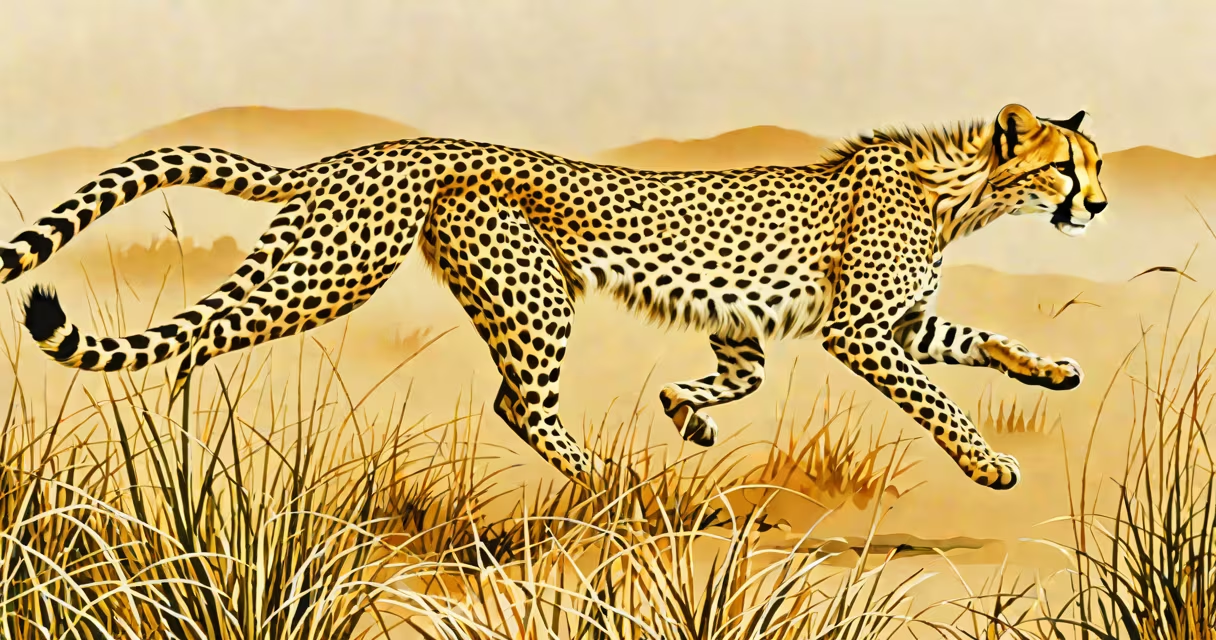
Cheetahs are the fastest land animals, reaching speeds of 60-70 mph (97-113 km/h) in short bursts. These big cats use their speed, lightweight build, and distinctive features to survive in the wild.
Cheetahs rely on their speed rather than stealth to hunt. They stalk prey within 200-300 feet (60-90 meters), then sprint in a straight line. Their flexible spines and long tails help them make sharp turns while maintaining balance. Unlike other big cats, cheetahs hunt during the day, primarily targeting antelopes like gazelles and impalas.
There are five recognized subspecies of cheetahs, primarily distinguished by their geographic locations:
| Subspecies | Region | Population |
|---|---|---|
| Northern Cheetah | East and North Africa | 3,500 |
| Southern African Cheetah | Southern Africa | 4,500 |
| East African Cheetah | East Africa | 2,500 |
| South African Cheetah | South Africa | 1,500 |
| Asian Cheetah | Iran | 50 |
Sources: IUCN Red List and Panthera.
Cheetahs inhabit different open landscapes, including savannas, grasslands, and semi-deserts. They prefer areas with plenty of visibility and cover for stalking prey. Historically, they lived across Africa, the Middle East, and parts of India. Today, their populations are concentrated in southern and eastern Africa, with a small population of Asian cheetahs remaining in Iran.
Cheetahs are classified as vulnerable by the International Union for Conservation of Nature (IUCN). Their numbers have declined due to habitat loss, human-wildlife conflict, and prey depletion. Conservation efforts focus on protecting habitats, reducing conflicts with livestock farmers, and breeding programs to increase their population.
Most people don't realize that cheetahs are not just fast-they're also highly social. While adult males often form coalitions, females raise their cubs alone. Cubs learn essential hunting skills through play, practicing their speed and agility from a young age.