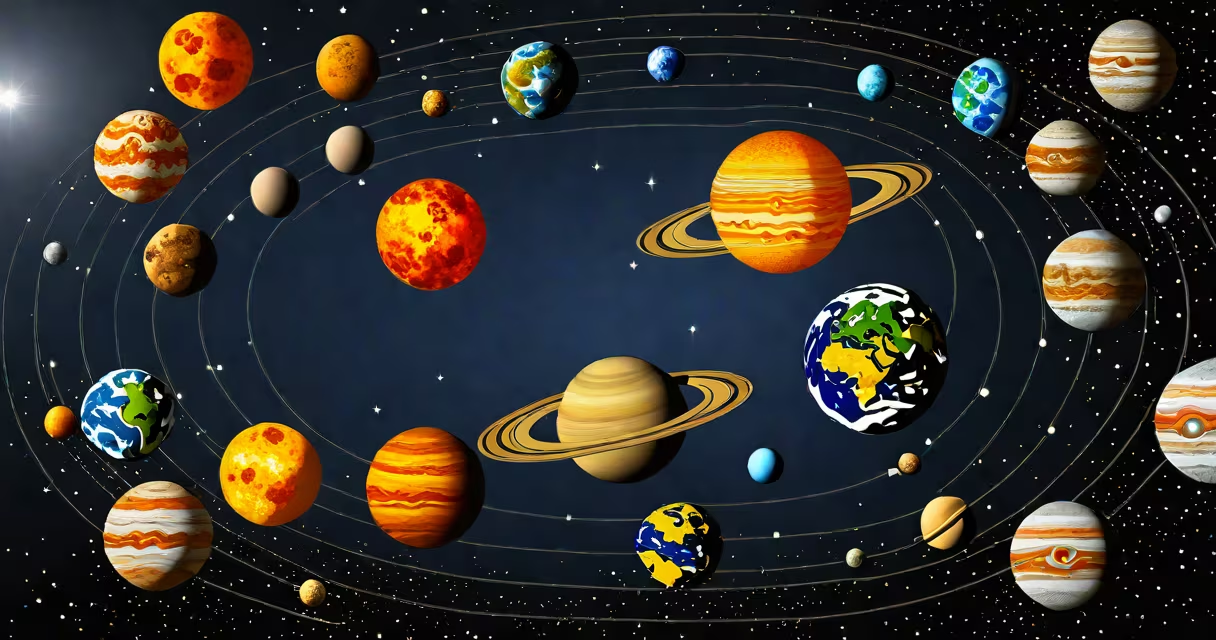
The solar system is our planetary neighborhood: eight planets orbiting the Sun, plus dwarf planets, moons, asteroids, and comets. NASA studies this system to understand its formation, evolution, and potential for life.
The solar system formed about 4.6 billion years ago from a collapsing cloud of gas and dust. Gravity pulled material together to form the Sun at the center, while leftover material formed the planets and other bodies. The Sun's gravity keeps everything in orbit, following Kepler's laws of planetary motion.
The solar system consists of:
NASA uses spacecraft, telescopes, and rovers to study the solar system. Examples include:
| Mission | Target | Launch Year |
|---|---|---|
| Voyager 1 | Jupiter, Saturn, interstellar space | 1977 |
| Mars Perseverance Rover | Mars | 2020 |
| James Webb Space Telescope | Entire solar system and beyond | 2021 |
These missions help scientists understand planetary geology, atmospheres, and potential habitability.
Many people think Pluto is still a planet, but it was reclassified as a dwarf planet in 2006. Others believe all planets orbit in perfect circles, but their orbits are actually elliptical. Some also mistakenly think the solar system is the entire universe, when it's actually just one small part.
Understanding our solar system helps us appreciate Earth's uniqueness and prepares us for future exploration. NASA's ongoing research continues to reveal new insights about our planetary neighborhood.