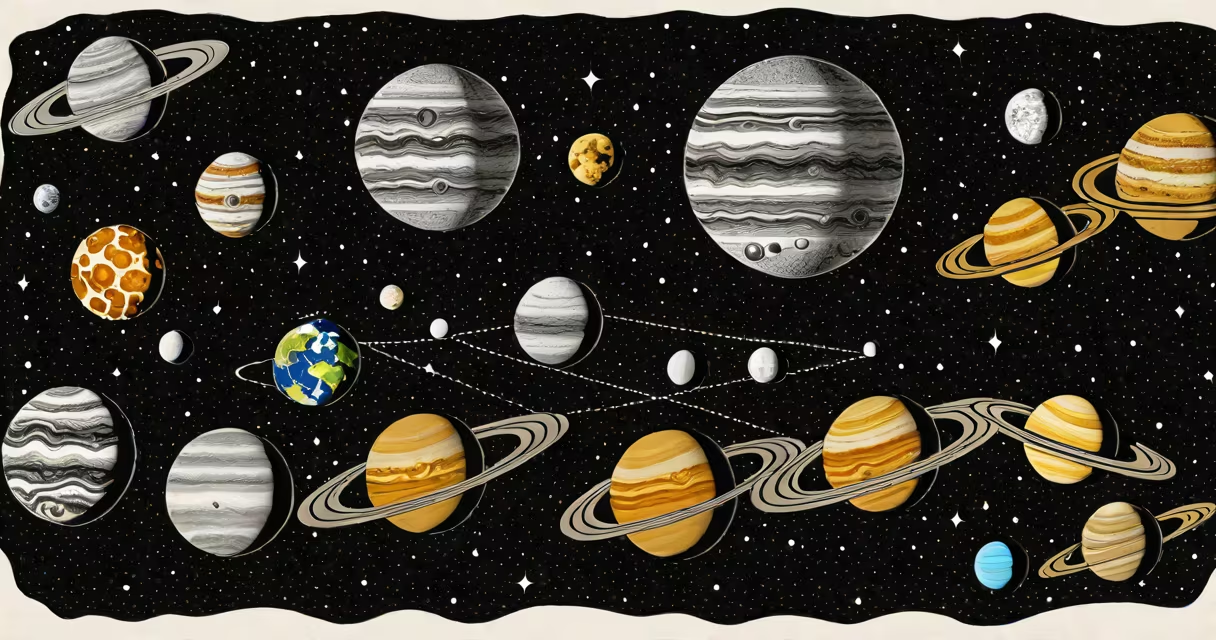
Our solar system contains eight planets, each with distinct characteristics, sizes, and orbits around the Sun. These planets are divided into terrestrial (rocky) and gas giants, with one ice giant.
The solar system formed about 4.6 billion years ago from a collapsing cloud of gas and dust. The Sun holds 99.8% of the system's mass, while the planets account for the remaining 0.2%. The eight planets orbit the Sun in elliptical paths, with their distances varying.
The solar system's planets fall into three categories based on composition:
| Type | Planets | Key Features |
|---|---|---|
| Terrestrial (Rocky) | Mercury, Venus, Earth, Mars | Dense, rocky surfaces, few moons |
| Gas Giants | Jupiter, Saturn | Mostly hydrogen and helium, many moons |
| Ice Giant | Uranus, Neptune | Icy materials like water, ammonia, methane |
Understanding solar system planets facts helps scientists study planetary formation, climate, and potential for life. For example, Mars' thin atmosphere and cold temperatures suggest it may have supported liquid water long ago.
Many people think Pluto is still a planet. However, the International Astronomical Union reclassified it as a dwarf planet in 2006 due to its small size and failure to clear its orbital path of other debris.
Another misconception is that all planets rotate in the same direction. While most do, Venus and Uranus rotate in the opposite direction due to unique gravitational interactions during their formation.
Take Jupiter, the largest planet in our solar system. Its diameter is about 86,881 miles, making it 11 times wider than Earth. Jupiter's Great Red Spot is a massive storm larger than Earth that has raged for centuries. The planet has 95 known moons, including Ganymede, the largest moon in the solar system, which is even bigger than Mercury.
I once used a telescope to observe Jupiter's bands of clouds and the shadows of its moons crossing its surface. Seeing these features firsthand highlighted the changing nature of our solar system.