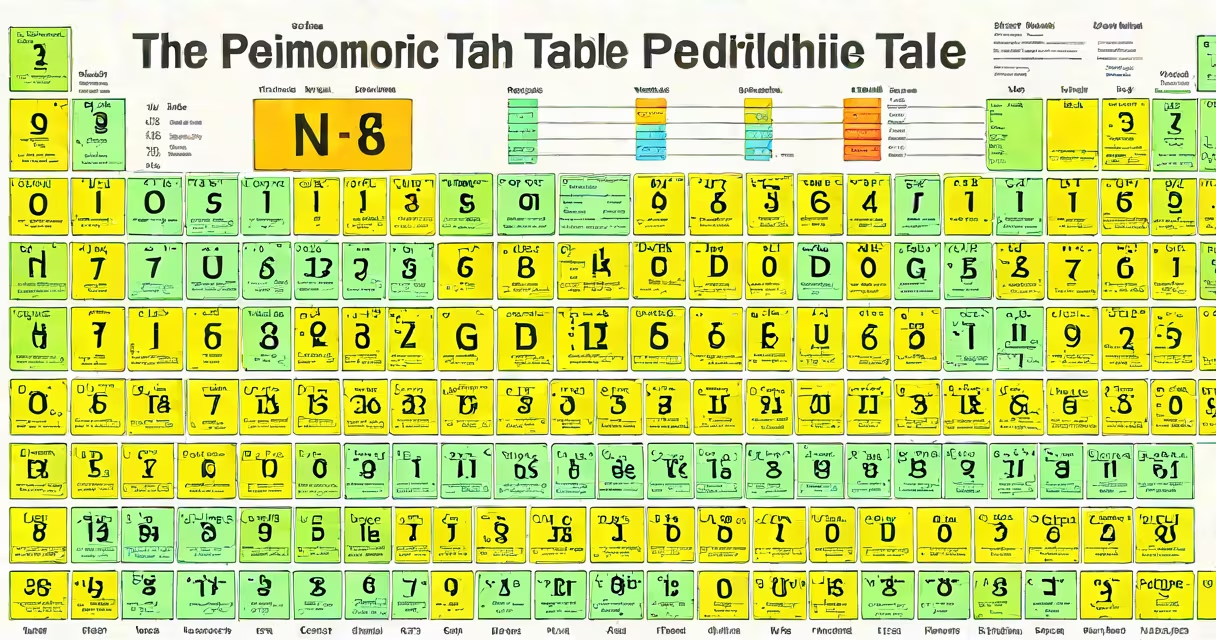
The numbers in the periodic table are called atomic numbers, representing the count of protons in an atom's nucleus. These numbers uniquely identify each chemical element and determine its position on the table.
Atomic numbers increase sequentially across the periodic table. Hydrogen, the lightest element, has an atomic number of 1, while heavier elements have higher numbers. This numbering reflects the number of protons, which equals the number of electrons in a neutral atom.
For example, carbon (atomic number 6) always has 6 protons and 6 electrons. The periodic table's structure groups elements with similar properties based on their atomic numbers and electron configurations.
| Element Group | Atomic Number Range | Examples |
|---|---|---|
| Alkali Metals | 3-37 (odd numbers) | Lithium (3), Sodium (11) |
| Transition Metals | 21-30, 39-57, etc. | Iron (26), Copper (29) |
| Halogens | 9, 17, 35, 53, 85 | Fluorine (9), Chlorine (17) |
| Noble Gases | 2, 10, 18, 36, 54, 86 | Helium (2), Neon (10) |
Atomic numbers define an element's chemical behavior. Elements in the same group share similar properties because they have the same number of valence electrons, the outermost electrons involved in chemical reactions.
For instance, all alkali metals (Group 1) have one valence electron, making them highly reactive. Fluorine (atomic number 9) and chlorine (atomic number 17) are both halogens, but chlorine is larger and less reactive due to its higher atomic number.
Some assume the numbers represent atomic mass or the order of discovery. However, atomic numbers solely indicate proton count. Atomic mass, shown below each element's symbol, accounts for protons and neutrons and often appears as a decimal due to isotopes.
For example, chlorine's atomic number is 17, but its atomic mass is approximately 35.45. This discrepancy arises because chlorine has multiple isotopes with different neutron counts, averaging the mass.
When I first learned about atomic numbers, I tested this concept by examining sodium (Na, atomic number 11). Knowing it had 11 protons helped me understand why it reacts violently with water-a trait shared by other alkali metals with similar atomic numbers.
This hands-on approach reinforced how atomic numbers serve as the foundation for predicting chemical behavior, a key insight for anyone studying chemistry.