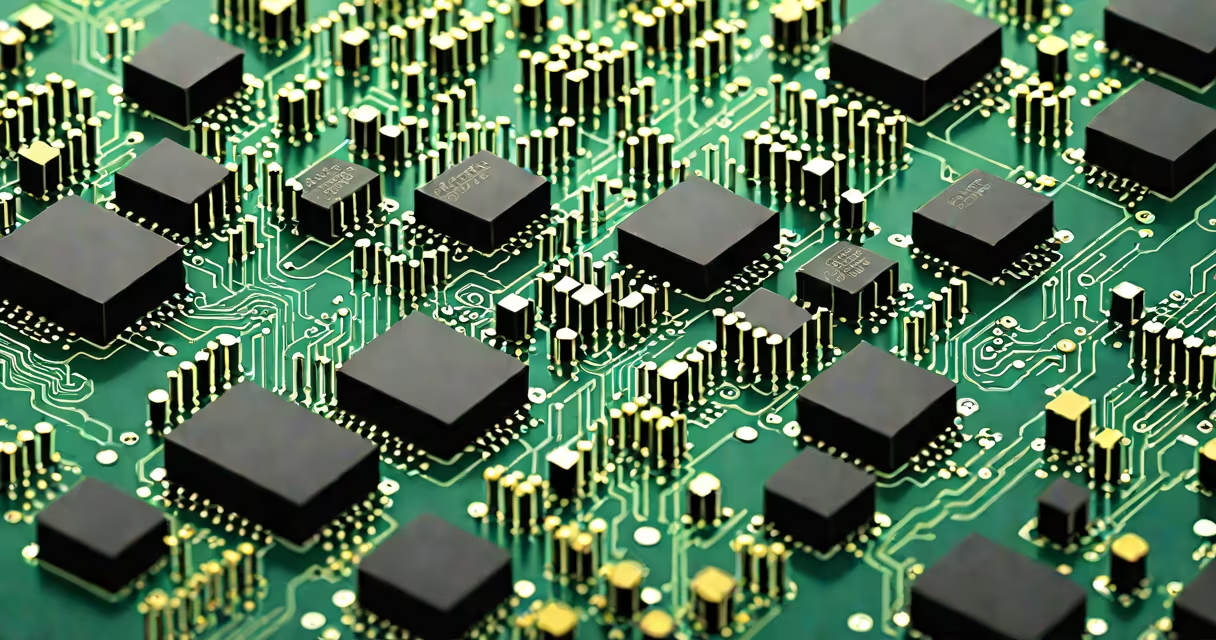
Integrated circuits (ICs) are miniature electronic circuits made from semiconductor materials that perform specific functions in electronic devices. These tiny chips contain transistors, resistors, capacitors, and other components etched onto a single piece of silicon.
ICs function by processing electrical signals through their internal circuitry. When electricity flows through the chip, the transistors act as switches, turning on and off rapidly to create binary code (1s and 0s). This allows ICs to perform calculations, store data, and control other electronic components.
There are several types of ICs, each designed for specific applications:
| Type | Function | Example |
|---|---|---|
| Analog ICs | Process continuous signals | Audio amplifiers |
| Digital ICs | Process binary signals | Microprocessors |
| Mixed-Signal ICs | Combine analog and digital functions | Smartphone processors |
| Power ICs | Manage power distribution | Voltage regulators |
ICs are found in almost all modern electronic devices. They're used because they're compact, efficient, and reliable. For example, a smartphone contains dozens of ICs that handle everything control.
According to the Semiconductor Industry Association, the global semiconductor market reached $555.9 billion in 2022, highlighting the widespread use of ICs. They're essential in computers, automotive systems, medical devices, and communication equipment.
Many people confuse integrated circuits with printed circuit boards (PCBs). While PCBs provide mechanical support and electrical connections for components, ICs are the actual miniaturized circuits that perform the functions.
Another misconception is that all ICs are the same. In reality, they vary greatly in complexity and function, from simple logic gates to complex microprocessors.
Consider a modern car. It contains numerous ICs that control everything from the engine management system to the infotainment display. The engine control module, for instance, uses ICs to monitor sensors and adjust fuel injection and ignition timing in real-time to improve performance and reduce emissions.
I once worked on a project where we integrated a custom IC into a medical device. The IC was responsible for processing signals from sensors and making real-time decisions based on those signals. This level of integration allowed the device to be both useful and compact, fitting comfortably in a doctor's hand.
Integrated circuits are the core of modern electronics, enabling devices to perform complex tasks efficiently and reliably. devices, ICs play a important role in our daily lives. Understanding their functions and applications can help appreciate the technology that powers our world.