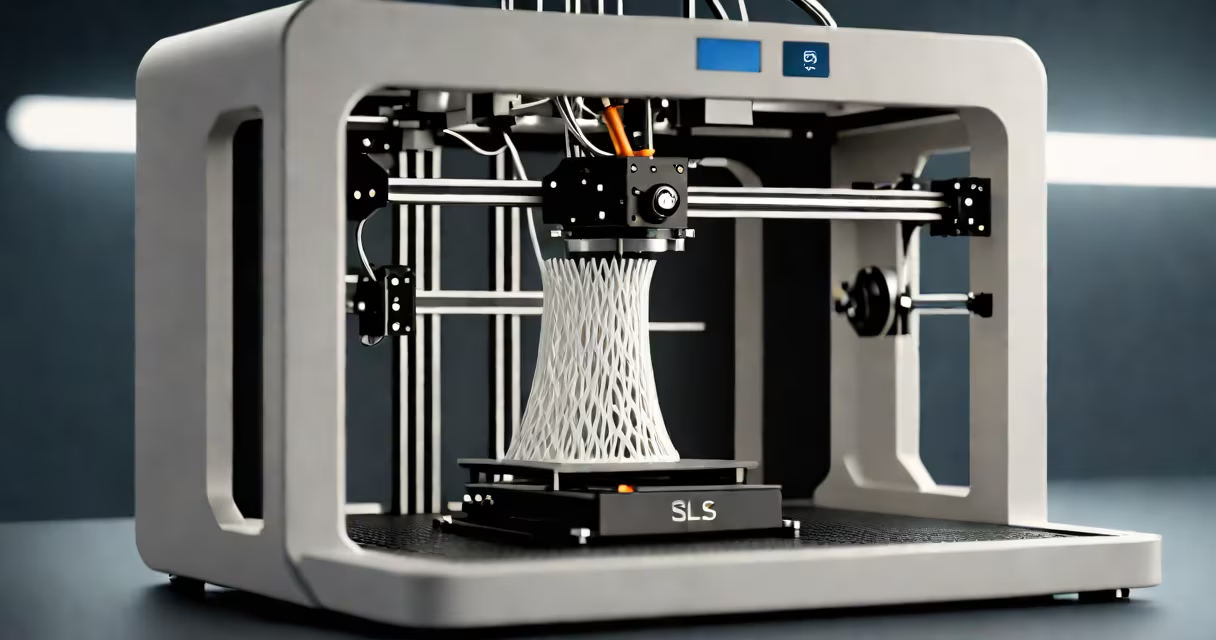
An SLS 3D printer uses a laser to sinter powdered material, binding particles together to create solid, functional plastic parts. This process differs from other 3D printing methods by using powder rather than filament or resin.
The SLS process starts with a thin layer of powder spread across the build platform. A CO2 laser then traces the cross-section of the part, heating and fusing the powder particles together. The platform lowers slightly, and another layer of powder is spread. This repeats until the entire part is complete.
Most SLS printers use nylon-based powders due to their strength and durability. Common materials include:
Some advanced SLS systems can process metals and ceramics, though these are less common.
SLS printing offers several key benefits over other 3D printing methods:
According to Materialise, SLS accounts for about 15% of all 3D printing applications, particularly in aerospace, automotive, and medical industries.
SLS 3D printing is widely used for:
One notable example is the use of SLS printing by Adidas to produce custom midsoles for their 4DFWD running shoes, demonstrating the technology's potential in high-performance consumer products.
While SLS shares similarities with other powder-bed fusion processes like DMLS (Direct Metal Laser Sintering), it differs from other common 3D printing methods:
| Technology | Material | Resolution | Typical Applications |
|---|---|---|---|
| SLS | Nylon powder | 0.1-0.15 mm | Functional prototypes, end-use parts |
| FDM | Thermoplastic filament | 0.1-0.4 mm | Prototyping, hobbyist projects |
| SLA | Photopolymer resin | 0.025-0.1 mm | High-detail models, dental applications |
SLS offers better mechanical properties than SLA (stereolithography) but typically lower resolution than FDM (fused deposition modeling).
SLS printing is generally more expensive than FDM due to higher equipment costs and material prices. However, it can be cost-effective for producing small batches of complex parts that would otherwise require tooling. According to Hubs, SLS parts typically cost between $50 to $500 depending on size and complexity.
SLS 3D printing represents a mature technology capable of producing high-quality, functional parts for demanding applications. Its ability to create complex geometries without support structures makes it particularly valuable for industrial applications where part performance is critical.