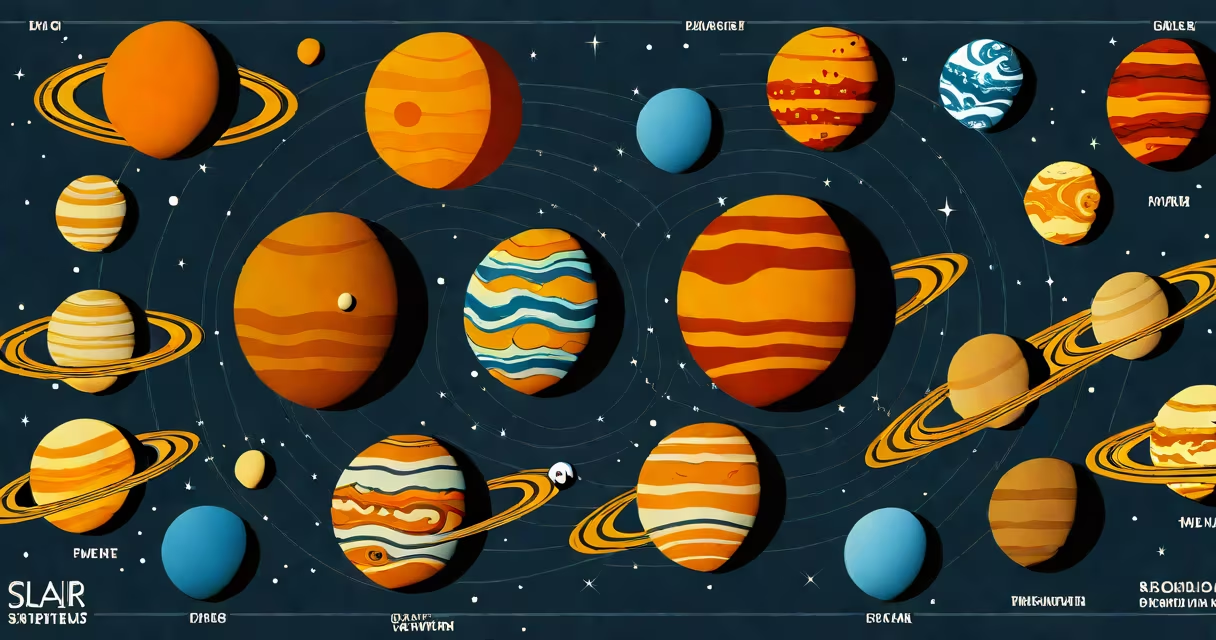
The eight planets in our solar system range from about 4,880 km (3,032 miles) in diameter for Mercury to 139,820 km (86,881 miles) for Jupiter. These sizes are measured as equatorial diameters due to most planets' oblate spheroid shapes.
Astronomers determine planet sizes using several methods. For nearby planets, radar measurements provide precise diameter data. For distant planets, astronomers analyze their apparent size and brightness compared to known standards. Spacecraft missions like NASA's Voyager and Cassini programs have provided direct measurements for outer planets.
Our solar system contains four terrestrial (rocky) planets and four gas giants, with distinct size ranges:
| Planet | Equatorial Diameter (km) | Type |
|---|---|---|
| Mercury | 4,880 | Terrestrial |
| Venus | 12,104 | Terrestrial |
| Earth | 12,742 | Terrestrial |
| Mars | 6,779 | Terrestrial |
| Jupiter | 139,820 | Gas Giant |
| Saturn | 116,460 | Gas Giant |
| Uranus | 50,724 | Ice Giant |
| Neptune | 49,244 | Ice Giant |
Understanding planetary dimensions helps scientists study planetary formation, atmospheric composition, and potential habitability. For example, Earth's size influences our magnetic field and plate tectonics, which are important for life. Jupiter's massive size affects the entire solar system's dynamics by acting as a gravitational shield that deflects comets and asteroids.
Planet sizes also help astronomers identify exoplanets. When a planet passes in front of its star (transits), the tiny dip in brightness reveals the planet's relative size compared to its star. NASA's Kepler mission has discovered thousands of exoplanets using this transit method.
Many people assume all planets are roughly similar in size, but the difference between Mercury and Jupiter is staggering - Jupiter could fit 1,321 Mercurys inside it. Another misconception is that Earth is the largest planet, when in reality it's the fifth largest in our solar system.
Some confuse planet sizes with mass. While size and mass are related, density plays a significant role. For example, Earth is only slightly larger than Venus, but 19% more massive due to its higher density.
To better visualize these enormous sizes, imagine:
When I visited the Smithsonian National Air and Space Museum, I saw a scale model of the solar system. The Earth was a marble, while Jupiter was a beach ball - the size difference was striking in person.
Exoplanets discovered in other star systems show even greater size variation. Some gas giants are larger than Jupiter but orbit extremely close to their stars, becoming "hot Jupiters." Others are smaller than Earth but may have Earth-like densities, making them potential candidates for habitability.
For more about comparing sizes in different contexts, see how clothing sizes work.