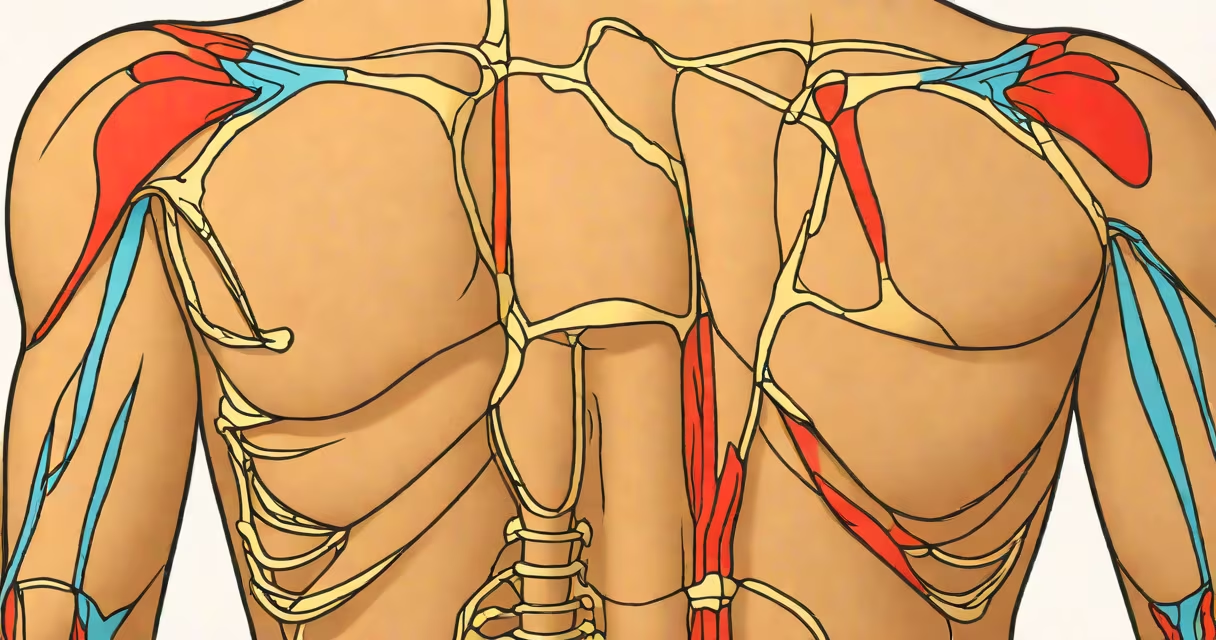
The scapula, or shoulder blade, is a flat, triangular bone located on the upper back between the shoulder and the spine. It connects with the humerus (arm bone) and clavicle (collarbone) to form the shoulder joint.
The scapula sits on the upper back, specifically between the second and seventh ribs. Its flat shape allows it to glide smoothly against the rib cage during arm movements. The bone has several key features:
The scapula doesn't connect directly to the spine - it's held in place by muscles and ligaments. This allows it to move in multiple directions:
This mobility makes the scapula important for arm rotation and overhead movements. When you raise your arm, the scapula rotates to allow the humerus to move freely.
Many people confuse the scapula with other shoulder structures:
| Misconception | Reality |
|---|---|
| Scapula is the same as the shoulder blade | Correct - these terms refer to the same bone |
| Scapula connects directly to the spine | False - it's connected by muscles, not bones |
| Scapula is the hard part you feel at the top of your shoulder | That's actually the acromion process of the scapula |
The scapula's position makes it vulnerable to certain injuries:
Physical therapy often focuses on scapular stabilization exercises to prevent these issues.
Unlike most mammals, humans have a highly mobile scapula that moves independently of the rib cage. This adaptation allows for our wide range of arm movements, including overhead throwing - a skill important to human tool development and hunting strategies throughout history.