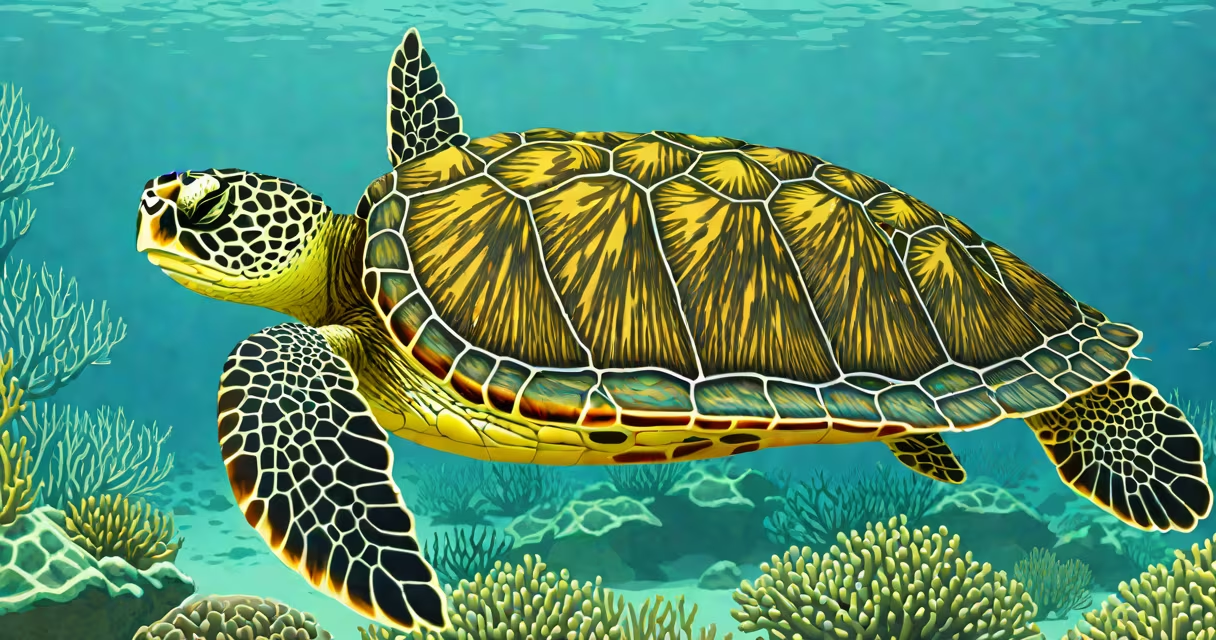
The hawksbill turtle (Eretmochelys imbricata) is a medium-sized sea turtle with a sharp, pointed beak resembling a bird's bill, overlapping scutes forming a jagged pattern on its shell, and two pairs of prefrontal scales on its head. These turtles measure 2-3 feet long and weigh 100-150 pounds.
The hawksbill's most recognizable feature is its hooked beak, which it uses to extract prey from coral crevices. Unlike other sea turtles, its shell has five overlapping scutes (scales) along the midline, creating a serrated appearance. The turtle's head displays two pairs of scales between its eyes, a trait shared only with the loggerhead turtle.
Hawksbills have a brown or golden-brown shell with lighter edges. Their skin ranges brown, often with dark spots or streaks. The turtle's carapace (upper shell) features a mosaic-like pattern created by the overlapping scutes, which are more pronounced in older individuals.
| Feature | Description |
|---|---|
| Beak | Sharp, hooked, bird-like |
| Shell | Overlapping scutes, jagged edges |
| Head scales | Two pairs of prefrontal scales |
| Coloration | Brown shell, yellowish skin |
Hawksbills inhabit tropical coral reefs worldwide, preferring shallow waters near coastlines. They are primarily nocturnal, feeding on sponges, jellyfish, and small fish. Unlike other sea turtles, hawksbills nest during the day, laying 3-6 eggs per clutch in sandy beach nests.
The hawksbill turtle is critically endangered due to habitat loss, pollution, and illegal trade of its beautiful shell. According to the International Union for Conservation of Nature (IUCN), global populations have declined by over 80% in the past century. Conservation efforts focus on protecting nesting beaches and enforcing wildlife trade laws.
Many people confuse hawksbill turtles with loggerheads due to their similar head scales. However, loggerheads lack the hawksbill's hooked beak and overlapping scutes. Another misconception is that hawksbills are aggressive-while they may bite when threatened, they are generally shy and avoid human contact.