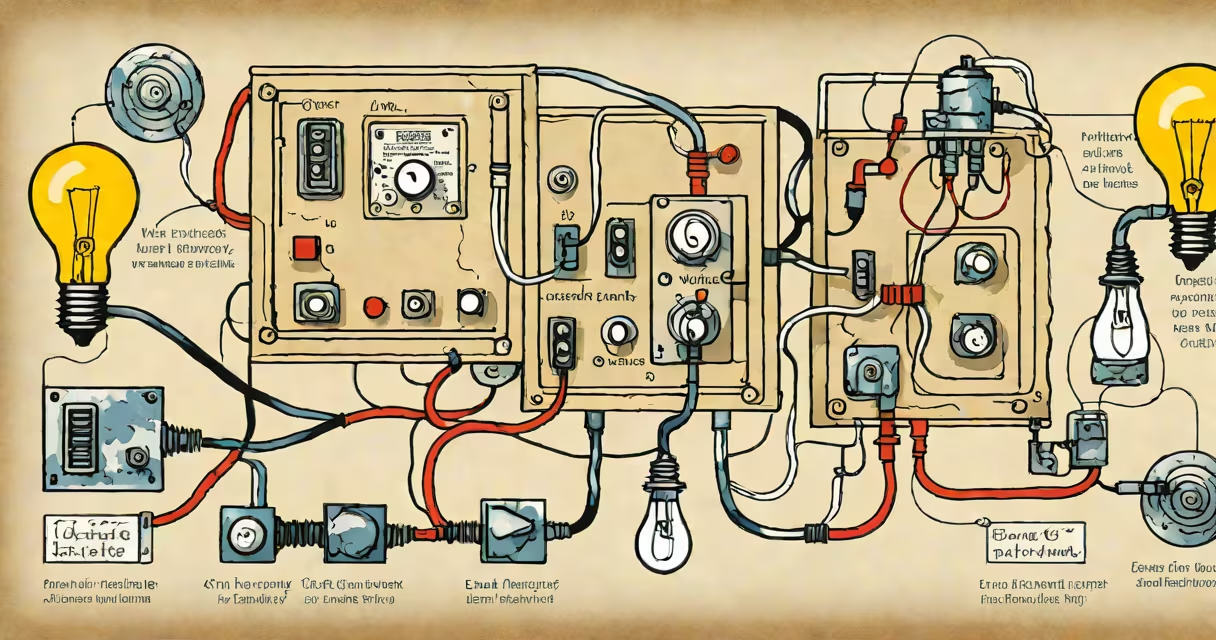
An electric circuit is a closed path that allows electric current to flow, consisting of a voltage source, conductive pathways, and one or more loads. Circuits power everything.
Circuits operate based on Ohm's Law: voltage (V) equals current (I) times resistance (R). A complete circuit requires:
When you flip a switch, you complete the circuit, allowing current to flow. The circuit in your home's light fixture contains a wire from the power source, a switch, a light bulb, and a return path back to the source.
| Component | Function | Example |
|---|---|---|
| Voltage Source | Provides electrical energy | Battery, generator |
| Conductor | Carries current with minimal resistance | Copper wire |
| Load | Uses electrical energy | Light bulb, motor |
| Switch | Controls current flow | Light switch |
| Resistor | Limits current flow | Potentiometer |
Circuits are classified by their current flow and connection types:
Most practical circuits are combinations. For instance, your home's electrical system uses parallel circuits to power different rooms independently, while each appliance may contain series circuits in its internal wiring.
Many people confuse electrical circuits with individual components or assume all circuits are simple series connections. In reality:
For example, a car's electrical system includes both series (starter motor circuit) and parallel (lighting circuit) elements. The battery provides voltage, cables act as conductors, and various switches control different circuits throughout the vehicle.
Circuits power nearly all electronic devices. Consider a smartphone:
Understanding circuits helps troubleshoot electrical problems. When my car's headlights stopped working, checking the circuit revealed a blown fuse - a simple component failure that broke the complete circuit.