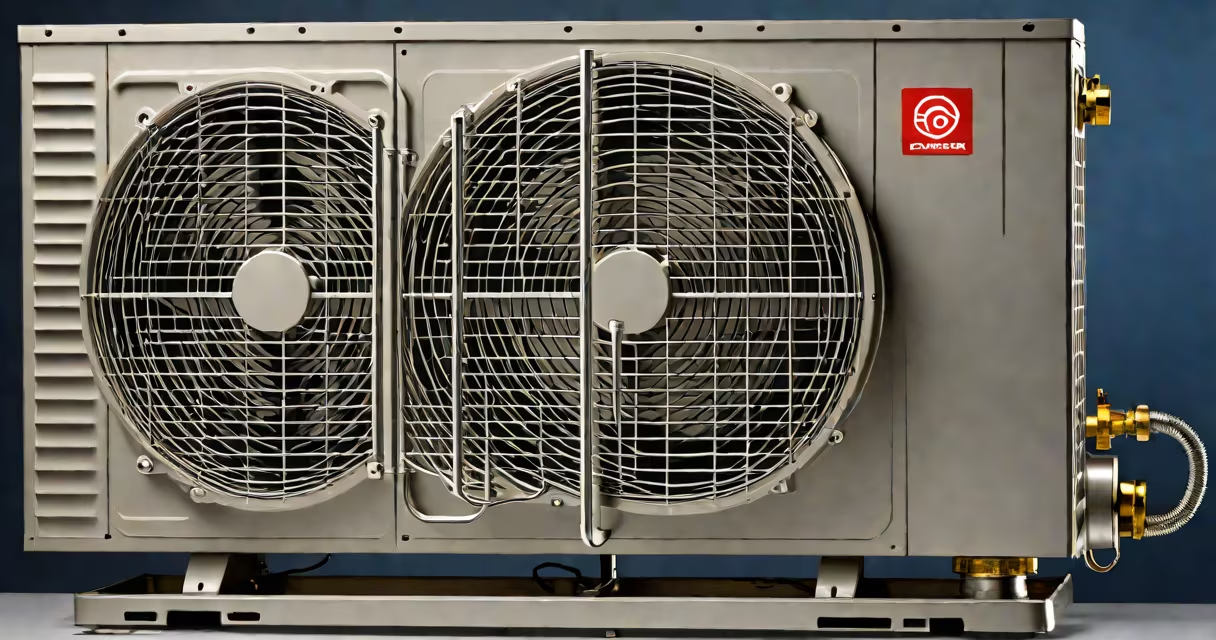
A condenser in HVAC is a heat exchanger that releases absorbed heat to the outside environment. It is important for the refrigeration cycle by converting high-pressure vapor refrigerant into liquid, allowing the system to cool indoor spaces.
The condenser operates as part of the refrigeration cycle in HVAC systems. After the refrigerant absorbs heat indoors, it travels to the condenser as a high-pressure vapor. The condenser's fan blows outside air over its coils, cooling the refrigerant and condensing it into a liquid. This process releases the absorbed heat outdoors, completing the cooling cycle.
HVAC condensers come in several types, each suited for different applications:
| Type | Description | Common Use |
|---|---|---|
| Air-Cooled Condenser | Uses outside air to cool refrigerant | Residential and small commercial HVAC systems |
| Water-Cooled Condenser | Uses water to cool refrigerant | Large commercial buildings and industrial applications |
| Evaporative Condenser | Combines air and water cooling | Hot climates where water is available |
Many people confuse the condenser with the evaporator coil, which absorbs heat indoors. While both are essential components of the refrigeration cycle, they serve opposite functions. The condenser releases heat outdoors, while the evaporator absorbs heat indoors.
Another common misconception is that the condenser only works in air conditioning systems. In reality, condensers are also used in heat pumps, which can provide both heating and cooling by reversing the refrigeration cycle.
In a typical residential air conditioning system, the condenser is located outdoors in the form of a large metal box with coils and a fan. When the air conditioner runs, the refrigerant travels from the indoor evaporator coil to the outdoor condenser. The condenser's fan blows air over the coils, cooling the refrigerant and releasing the absorbed heat into the outside environment.